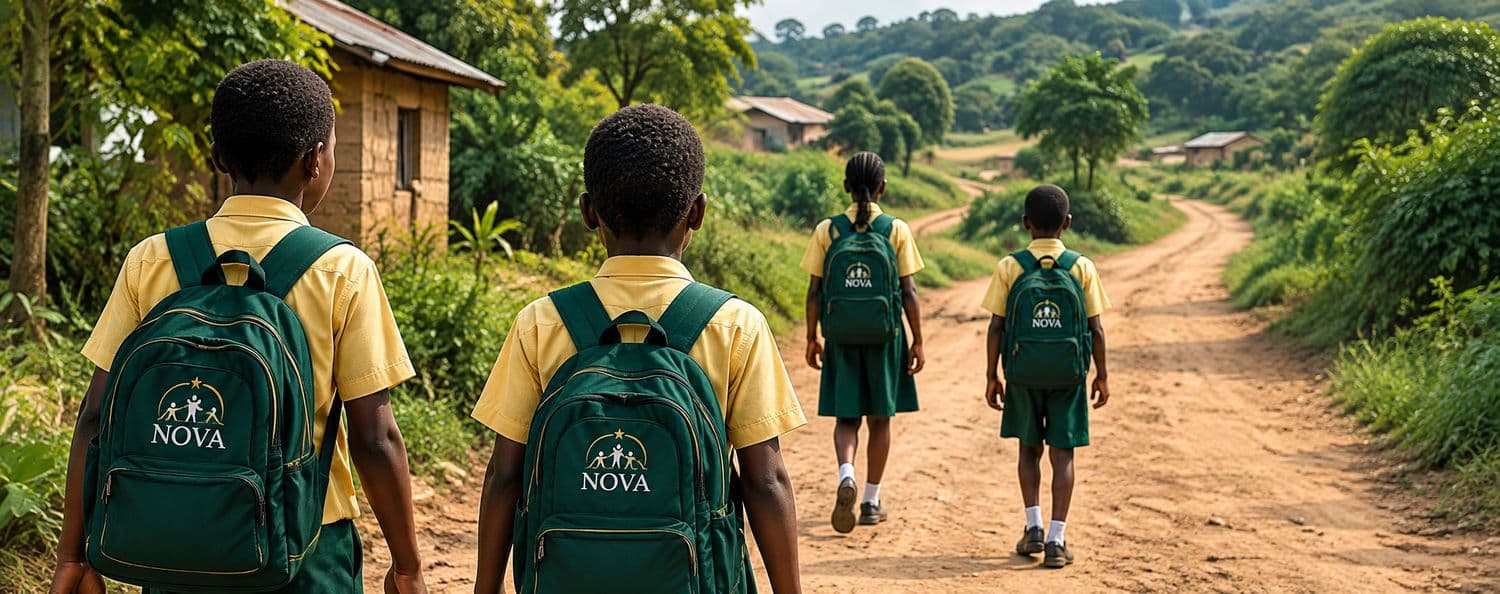

The most important people in NOVA's work are not sitting in an office.
They are in classrooms.
In homes.
At clinics.
Around community tables.
They are the parents trying to keep their children in school. The teachers who see which children arrive without the basics. The community leaders who understand which families are struggling long before that struggle becomes visible to everyone else.
That is why NOVA believes something simple:
We should not design solutions for communities without listening to the people who live there.
NOVA starts by listening.
The people closest to the problem usually see it first
A parent knows when the cost of school supplies has become difficult.
A teacher knows when a child repeatedly arrives without the materials needed to participate.
A clinic knows when a family needs urgent care but cannot find the money to get there.
A community leader often knows which households are quietly struggling.
These perspectives matter because a programme can look excellent on paper and still fail when it meets reality.
Before launching an intervention, NOVA's approach is to ask:
What is the problem?
Who is affected?
What has already been tried?
What would actually help?
What could make the programme fail?
These are not questions asked for the sake of a report.
They help determine whether NOVA is solving the right problem in the first place.
What parents want is often simple
For many parents, dignity is not complicated.
They want their children to have what they need to learn.
They want to be able to respond when a child becomes sick.
They want their children to eat.
And when they need help, they do not necessarily want a complicated intervention.
They want someone to understand the problem and provide useful support.
That is why NOVA's programmes are deliberately practical.
School Kit addresses basic school materials and uniform needs.
Care Ride addresses transport barriers that can prevent families from reaching urgent medical care.
Holiday Table addresses food access for children during school breaks.
Three different problems.
One underlying philosophy:
Remove the barrier that is standing in the way of the next step.
Teachers see what statistics cannot
A number can tell us how many children received school materials.
A teacher can tell us what it means when a child finally has them.
Teachers are also an important part of NOVA's identification and follow-up process.
The foundation's model calls for schools and community partners to help identify children who need support, validate needs and support follow-up.
That matters because beneficiary selection should not be based simply on whoever happens to know someone at NOVA.
It should be grounded in the community.
And the relationship should not end when a kit is handed over.
NOVA's pilot model includes follow-up with schools so the foundation can understand what happened after delivery and learn from the experience.
Community leaders bring another kind of knowledge
There are things that cannot be understood from a spreadsheet.
Who is trusted in the community.
Which families are genuinely vulnerable.
What local conditions could affect an intervention.
Which approach might create unintended problems.
Who can help coordinate volunteers.
Where a programme could fail.
This is why NOVA sees community leaders as partners, not simply people to inform after a decision has already been made.
The same principle applies to local volunteers, clinics, drivers, schools and food suppliers.
The community is not simply where NOVA delivers programmes.
The community is part of how NOVA designs them.
Listening also means being willing to change
There is a temptation in charitable work to arrive with a solution already decided.
NOVA's approach is different.
If people on the ground tell us that something will not work, we need to listen.
If a process creates unnecessary difficulty, we need to change it.
If a programme is solving the wrong problem, we need to recognise that before expanding it.
And if something works, we need to understand why it worked.
That is part of building an institution rather than simply running a series of charitable activities.
This is also why NOVA measures
Listening tells us what people need.
Records tell us what actually happened.
NOVA's measurement system is designed to track things such as:
- Children supported
- School kits delivered
- Transport cases supported
- Meals served
- Communities reached
- Active volunteers
- Programme spending
- Administration spending
- Complaints received
- Complaints resolved
The principle is straightforward:
Every number should have a record behind it.
NOVA should never publish a number simply because it sounds impressive.
If we say 30 children received support, there should be documentation showing those 30 interventions.
If we say meals were served, there should be a record.
If something went wrong, that should be part of what we learn from too.
Accountability is not something we add after the work.
It is part of the work.
The community should never become a backdrop
There is another reason these voices matter.
People are not props for an organisation's story.
Children are not marketing material.
Families should not have to surrender their dignity to receive support.
NOVA's safeguarding framework calls for proper consent around photographs and storytelling, safe handling of beneficiary information and clear rules for working with children and families.
The story should protect the person.
Not the other way around.
So when we tell stories from the community, we want them to be human, factual and respectful.
Where consent allows, we can share names, voices and experiences.
Where it does not, we protect identities.
The work comes first. The story comes second.
What NOVA's presence should mean
We do not want the community to remember NOVA simply as the organisation that came with bags, food or a vehicle.
We want something deeper.
A parent should know there is a responsible organisation willing to listen.
A teacher should know there is a partner interested in solving practical barriers.
A community leader should know that local knowledge matters.
A volunteer should know that showing up is part of a larger system.
And a child should experience support without losing their dignity.
That is the kind of presence NOVA is trying to build.
Not loud.
Not performative.
Consistent.
From being helped to helping others
There is a bigger vision behind this.
NOVA's long-term model is not simply:
Need → Support.
It is:
Need → Support → Stability → Participation → Leadership → Giving back.
A child who receives a school kit today may one day become a teacher.
A volunteer may eventually become a community coordinator.
A community coordinator may eventually help another community build its own programme.
The point is not to create permanent dependence on NOVA.
The point is to help create conditions where people can move forward and eventually become part of helping others.
That is a much bigger definition of impact.
So, what does NOVA's presence mean?
We could answer that question ourselves.
But we would rather let the people closest to the work answer it.
Because NOVA is not being built to speak for communities.
It is being built to work with them.
To listen before acting.
To respond to specific needs.
To document what happens.
To learn.
To improve.
And to keep showing up.
NOVA shows up.
Not because we believe we have every answer.
But because we believe the people closest to the problem deserve to be heard, respected and included in finding the answer.
And that is where every NOVA intervention should begin.
With listening.
NOVA Empowerment Charitable Foundation helps children and vulnerable families overcome the small barriers that can derail their next step. Practical help. Delivered consistently.
COMMENTS
Leave a comment
Comments open as soon as the site is connected to the CMS.