
It is easy to say:
“We helped 30 children.”
It is much harder to prove it.
Who were the 30 children?
What support did each child receive?
When was it delivered?
Where did it happen?
What did it cost?
Was the support actually needed?
What happened afterward?
At NOVA, these questions matter because we do not believe impact should be measured by how impressive a number sounds.
Every number should have a record behind it.
The number is only the beginning
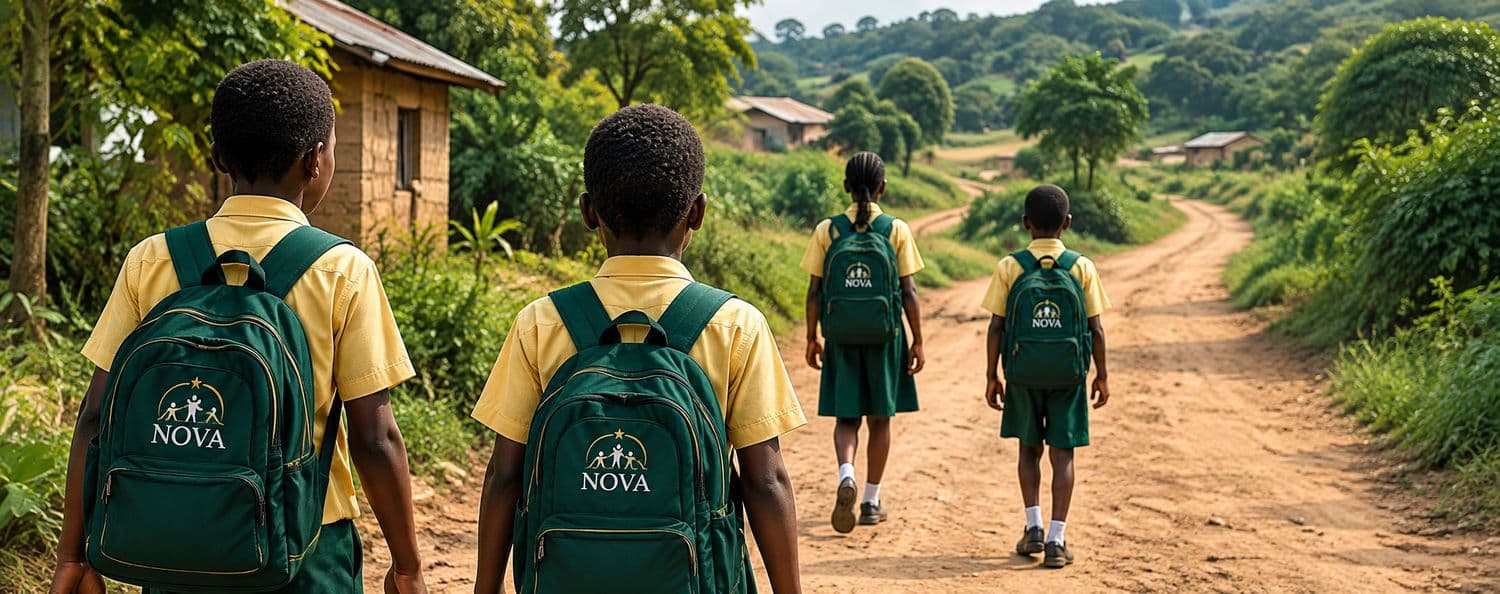
Imagine NOVA reports that 30 school kits were distributed.
That sounds like a result.
But on its own, it tells us very little.
A responsible record should allow us to understand the intervention behind that number.
For the School Kit pilot, NOVA's records are designed to capture information such as the child's identification or reference number, school, class, age, items received, date received, referring teacher or community contact, and required consent documentation.
The purpose is not to collect information for the sake of collecting it.
It is to make the work traceable.
If a donor asks where their money went, we should be able to answer.
If the team wants to review what happened, the information should be there.
If something went wrong, we should be able to identify it.
If we want to improve the programme, we need evidence to work from.
We measure the work, not just the applause
There are numbers that look good online.
Followers.
Reach.
Likes.
Views.
But those numbers do not necessarily tell us whether a child received a school kit, whether a family reached urgent medical care or whether children were fed during a school holiday.
So NOVA's internal measurement focuses first on the work itself.
Every month, leadership should be able to see:
| What we measure | Why it matters |
|---|---|
| Children supported | Shows how many people received direct support |
| School kits delivered | Tracks the School Kit programme |
| Transport cases | Tracks Care Ride interventions |
| Meals served | Tracks Holiday Table delivery |
| Communities reached | Shows where NOVA is operating |
| Active volunteers | Shows operational capacity |
| Donor income | Tracks resources entrusted to NOVA |
| Programme spending | Shows where programme funds went |
| Administration spending | Helps maintain financial discipline |
| Complaints received | Shows where people experienced problems |
| Complaints resolved | Shows whether NOVA responded |
These numbers are reviewed monthly and year to date.
Because a foundation should know what happened last month, not discover it a year later.
What gets measured gets questioned
Good measurement creates uncomfortable questions.
Why did one intervention cost more than another?
Why did fewer people receive support this month?
Why did a programme take longer than expected?
Why did a complaint occur?
Why did a particular community require a different approach?
Those questions are useful.
They prevent us from becoming too comfortable with simply saying:
“Everything went well.”
Sometimes it did.
Sometimes it did not.
And sometimes the most valuable lesson is found in what went wrong.
We do not want vanity impact
NOVA's first year is deliberately designed around evidence rather than vanity.
The foundation's working ambition is to build towards meaningful outcomes such as children supported, school kits delivered, transport cases assisted and meals served, while developing a documented system that another person can actually operate.
That last part matters.
Because a strong organisation should not collapse when one person steps away.
The system should work.
The records should exist.
The processes should be understandable.
The responsibilities should be clear.
And the results should be verifiable.
Tracking begins before the intervention
Measurement does not begin when the photograph is taken.
It begins during planning.
For example, before a School Kit distribution, NOVA needs to know:
Who is being supported?
Why were they selected?
What do they need?
What will each kit contain?
What will it cost?
Who is responsible for delivery?
Then comes the intervention.
And afterward:
Was the kit delivered?
What was received?
When was it received?
What follow-up is needed?
That creates a chain of evidence.
Need → Support → Record → Follow-up → Learning
Different programmes need different records
The same measurement system cannot simply be copied across every intervention.
For School Kit, NOVA needs to track the child, school, items provided and delivery.
For Care Ride, the process is different. A case comes through an approved clinic, community contact or designated NOVA officer. The need is verified, transport is approved, the driver is paid through a controlled process, the case is recorded and follow-up confirms whether the person reached the facility.
For Holiday Table, NOVA needs to understand how many children are being served, how many meals are prepared and delivered, where the programme takes place and what resources were used.
Different intervention.
Different evidence.
Same principle: know what happened.
The donor deserves more than a thank-you message
When someone gives to NOVA, they are entrusting the foundation with something.
Their money.
Their confidence.
Their reputation.
Their belief that the organisation will use what it receives responsibly.
That means donor accountability cannot stop at:
“Thank you for supporting us.”
The stronger relationship is:
Here is the problem.
Here is the intervention.
Here is what it cost.
Here is what your support helped make possible.
Here is what happened.
Here is what we learned.
And then:
Here is what comes next.
That is the kind of reporting NOVA wants to build.
Sometimes the number is small. It still matters.
NOVA does not need to inflate its numbers to make the work meaningful.
If 20 children receive meals during a pilot, we should say 20.
If 10 families receive transport support, we should say 10.
If 30 children receive school kits, we should say 30.
Then we should explain what happened.
A small, well-documented intervention can teach us more than a large programme that nobody properly records.
Scale without control is not impact.
Every number has a story behind it
Thirty school kits are thirty children with individual records.
Ten transport cases are ten situations that required verification and follow-up.
A hundred meals are resources purchased, prepared, served and accounted for.
A complaint is not simply a negative statistic.
It is a signal that something needs attention.
And a resolved complaint tells us something about how NOVA responds when the system does not work perfectly.
This is why numbers matter.
They turn good intentions into something that can be examined.
We are building something that can outlive the founder
The founder's story began with Thursday meals.
That story matters.
But NOVA cannot remain dependent on one person's memory, relationships or ability to personally oversee every intervention.
The organisation needs systems.
That means defined responsibilities.
Policies.
Financial controls.
Records.
Measurement.
Review.
Accountability.
The goal is simple:
The founder may start the work. The system must be able to continue it.
That is what turns a personal act of generosity into an institution capable of serving people consistently.
The real question is not “How many?”
It is:
How many?
Who?
Where?
What did they receive?
Why did they need it?
What did it cost?
What happened next?
What did we learn?
Those questions may not make the flashiest social media post.
But they help build something much more valuable:
Trust.
And trust is one of the things NOVA intends to earn slowly, through consistent work.
Every number has a record.
Every record helps us learn.
Every lesson helps us improve.
And every improvement helps us serve better.
NOVA Empowerment Charitable Foundation helps children and vulnerable families overcome the small barriers that can derail their next step. Practical help. Delivered consistently.
COMMENTS
Leave a comment
Comments open as soon as the site is connected to the CMS.